
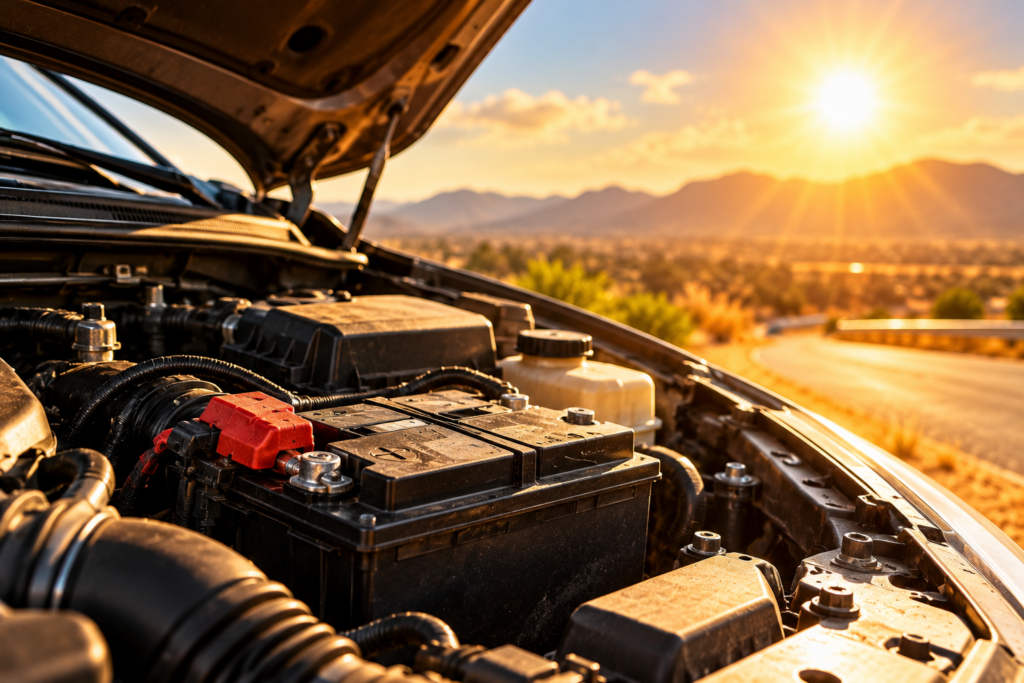
When South African drivers think about car battery problems, cold winter mornings often come to mind. But summer heat can be just as damaging, and in some cases more damaging, to the long-term health of a car battery. A vehicle may start perfectly on a hot afternoon while the heat quietly accelerates chemical changes inside the battery.
From Johannesburg traffic to the hotter conditions experienced in parts of Limpopo, the Northern Cape and KwaZulu-Natal, South African motorists regularly expose their vehicles to high temperatures. Understanding how heat affects a car battery can help you avoid unexpected breakdowns, recognise early warning signs and protect your battery before the December holiday season.
Does Hot Weather Really Damage Car Batteries?
Yes. Most conventional automotive starting batteries use lead-acid chemistry. Higher temperatures can temporarily make the battery’s chemical reactions more active, but prolonged exposure to excessive heat also accelerates internal deterioration. The result can be a battery that loses capacity and reaches the end of its useful life sooner than expected.
The temperature under a vehicle’s bonnet can be considerably higher than the surrounding air, particularly after driving or when sitting in slow-moving traffic. The battery’s position, the vehicle’s design and the condition of its cooling and charging systems all influence its exposure.
Heat-related damage is often gradual rather than dramatic. You may not notice anything unusual until the battery has lost enough reserve capacity to struggle with starting the engine.
Why Summer Heat Can Be Harder on a Battery Than Winter
Cold weather mainly reduces the power a battery can deliver at that moment and makes starting more demanding. Heat, by contrast, can speed up the processes that age a battery permanently. This is why a battery weakened by months of high temperatures may finally fail during a cooler morning when the engine needs more starting power.
It is not accurate to say that every hot day is worse than every cold day. Both extremes create different problems. However, sustained high temperatures are a major factor in long-term battery ageing, especially when combined with frequent short trips, high electrical loads or an already ageing battery.
Five Ways High Temperatures Affect Your Car Battery
Understanding what happens inside the battery makes it easier to see why summer maintenance matters.
1. Faster Internal Corrosion
Heat accelerates corrosion of internal battery components, including the positive grid in many lead-acid designs. Over time, this can reduce the battery’s ability to store and deliver the energy required for reliable starting. Internal corrosion cannot simply be cleaned away like corrosion on the external terminals.
2. Water Loss in Some Battery Designs
High temperatures can increase water loss in vented lead-acid batteries. Low electrolyte levels can expose internal plates and contribute to damage. Many modern batteries are sealed or maintenance-free and should never be opened by the owner. Only check or top up electrolyte if the manufacturer specifically permits it and you know the correct procedure.
3. Faster Self-Discharge
A battery naturally loses some charge while standing unused. Warmer conditions can increase the rate of self-discharge, which becomes more important if the vehicle is parked for weeks at a time. Modern vehicles also use a small amount of power for alarms, security and electronic systems when switched off.
4. Greater Demands From Vehicle Accessories
Summer driving often means more use of air conditioning, fans, infotainment and phone charging. With the engine running, the alternator normally supplies these loads, but repeated short journeys and heavy electrical demand can make it harder to replenish a battery that is already undercharged. Air conditioning itself is not proof that a battery is failing; the wider charging conditions matter.
5. Reduced Battery Lifespan
A battery exposed to prolonged heat may age faster than one used in milder conditions. There is no universal lifespan that applies to every vehicle in South Africa. Battery quality, charging performance, driving patterns, vehicle design and maintenance all play a role. A battery can be several years old and still test well, while a younger battery can fail prematurely.
Signs Your Car Battery May Be Struggling in Summer
A heat-weakened battery does not always display obvious damage. Watch for these practical warning signs:
- The engine turns over more slowly than normal, especially after the car has stood overnight.
- You need more than one attempt to start the vehicle.
- Interior lights or dashboard displays dim noticeably during starting.
- The stop-start system stops operating consistently.
- The battery repeatedly goes flat or needs jump-starting.
- Electrical settings reset unexpectedly after starting.
- You notice swelling, cracks, leaks or unusual odours around the battery.
These symptoms can also indicate charging-system faults, poor connections or electrical drains. If the battery is swollen, leaking or unusually hot, do not handle or charge it yourself. Arrange professional assistance.
How to Protect Your Car Battery During a South African Summer
A few sensible habits can reduce avoidable strain and help you spot problems early.
Park in Shade When Practical
Parking under cover or in shade can reduce direct sun exposure to the vehicle. This will not eliminate under-bonnet heat, but it can help limit unnecessary temperature build-up when the car is parked. Never sacrifice parking safety or security simply to find shade.
Have the Battery Tested Before a Long Trip
A professional battery test is particularly useful before December holiday travel, especially if the battery is older or the vehicle has shown signs of slow starting. Ask for a check of battery condition, starting performance and the charging system rather than relying only on a resting voltage reading.
Keep Terminals and Connections in Good Condition
Loose or corroded terminals can cause voltage drops and starting problems that resemble a weak battery. Inspect visible connections for corrosion and damage. If cleaning or tightening is needed, have it done safely, particularly on vehicles with complex electronics or battery-management systems.
Avoid Leaving the Battery Deeply Discharged
Repeated deep discharge can shorten the life of a starting battery. Switch off unnecessary accessories when the engine is not running and investigate unexplained flat batteries. If the car will stand unused for a long period, a manufacturer-approved battery maintainer may be helpful.
Do Not Rely Only on Short Trips
Starting the engine uses battery energy. A series of very short drives may not provide enough time to replace that energy, particularly if the battery is ageing or the vehicle has high electrical demand. An occasional longer drive can help, but a proper charger is often more effective for a significantly discharged battery.
Make Sure the Correct Battery Is Fitted
Modern vehicles may require an AGM or EFB battery rather than a conventional flooded battery. Choosing the wrong type or specifications can lead to poor performance and shortened service life. Follow the vehicle manufacturer’s requirements for size, capacity, cold cranking amps, terminal layout and battery technology. Some vehicles also require battery registration after replacement.
Can Summer Heat Cause a Car Battery to Die Overnight?
A battery can appear to fail overnight, but the underlying damage may have developed over months. After a hot day, an ageing battery might no longer have enough reserve to start the engine the next morning. Alternatively, an interior light, faulty accessory or parasitic drain could be responsible.
If the vehicle suddenly refuses to start, do not assume the weather alone caused it. Have the battery tested and check for charging faults or excessive current draw if the problem repeats.
Does Air Conditioning Drain Your Car Battery?
When the engine is running, the charging system normally supplies the electrical power required by the vehicle. Air conditioning can increase overall engine and electrical demand, depending on the system, but using it normally should not flatten a healthy battery while driving.
Problems are more likely if the battery is already weak, the charging system is underperforming or electrical accessories remain on while the engine is off. If the car struggles to start after running accessories, the battery and charging system deserve a proper check.
Should You Replace Your Battery Before Summer?
Not automatically. Age alone does not prove that a battery needs replacing. If your battery is approaching the later part of its expected service life, has required a jump-start or is showing slow-cranking symptoms, arrange a test before peak summer travel.
A battery specialist can assess its state of charge and ability to deliver starting current. If the battery tests poorly, replacing it before a long trip may be more practical than waiting for a roadside breakdown. If it tests healthy, focus on correct charging and routine inspection.
Summer Battery Checklist Before a Road Trip
Before travelling long distances in South Africa, use this simple checklist:
- Check whether the engine starts promptly and consistently.
- Inspect the battery casing for cracks, swelling or leaks.
- Look for visible terminal corrosion or loose connections.
- Have an older or suspicious battery professionally tested.
- Check the charging system if the battery warning light appears.
- Confirm that the correct battery type is installed.
- Avoid leaving accessories switched on during stops.
- Save the contact details of roadside assistance before departure.
A quick battery check is a small step that can prevent a major interruption to a holiday or business journey.
Frequently Asked Questions
Is hot weather bad for car batteries?
Yes. Prolonged high temperatures can accelerate internal corrosion and other ageing processes in lead-acid batteries, potentially shortening their lifespan.
Can a car battery fail in summer even if it worked in winter?
Yes. Battery condition changes over time. A battery that started reliably in winter may deteriorate through months of heat and later struggle to provide sufficient starting power.
How long does a car battery last in South African heat?
There is no fixed lifespan. Climate, battery construction, vehicle usage, charging conditions and maintenance all influence service life. Testing is more useful than assuming a battery is healthy or faulty based only on age.
Does parking in the sun damage a car battery?
Repeated heat exposure can contribute to battery ageing. Parking in shade may reduce some heat build-up, although heat generated under the bonnet while driving is also important.
Should I add water to my battery during summer?
Only if you have a serviceable battery and its manufacturer explicitly allows electrolyte maintenance. Never open a sealed or maintenance-free battery. Ask a battery specialist if you are unsure.
Why does my battery go flat after a hot day?
Heat may have contributed to long-term battery deterioration, but the immediate cause could also be an alternator fault, a weak battery, poor connections or an electrical drain. Testing is the best way to identify the problem.
Keep Your Car Starting Reliably This Summer
South African summers can be demanding on car batteries. While cold mornings make starting problems easier to notice, prolonged heat can quietly shorten battery life by accelerating internal wear. That makes summer battery care about more than simply getting the engine started today.
Inspect the battery for visible problems, pay attention to slow starting, avoid repeated deep discharge and arrange professional testing before a long journey. If the battery is ageing or showing warning signs, addressing the problem early can help keep you moving through the hottest months of the year.